| We'll start from the possibility of request a test lens to ART-LENS in order to do the lens adaptation.
1st.- CASE OF NEW CONTACT LENS
1.1. FIRST VISIT: Choice of lens type and test lens request
CHOOSE LENS TYPE: A Type, D Type, E Type...
Types of Lenses
A Type 
Transparent pupil, iris with color, and lens with vision
- Moisturizing: 38%
- Power: +/- 20.00D
- Total diameter: 12.5mm to 16mm |
 |
Filter 
25%, 50%, 75% Intensity, lens with vision.
- Mosturizing: 38%
- Power: +/- 20.00D
- Total diameter: 12.5mm to 16mm
- Iris diameter: 10mm to 14mm |
 |
D Type 
Black pupil, iris with color, lens without vision.
- Moisturizing: 38%
- Total diameter: 12.5mm to 16mm
- Iris diameter: 10mm to 14mm
- Pupil diameter: 2mm to 8mm |
 |
E Type 
Black pupil, transparent iris, lens without vision.
- Moisturizing: 38%
- Total diameter: 12.5mm to 16mm
- Pupil diameter: 2mm to 8mm |
 |
Pinhole 
Transparent pupil, black iris, lens with vision.
- Moisturizing: 38%
- Total diameter: 12.5mm to 16mm
- Iris diameter: 10mm to 14mm
- Pupil diameter: 2mm to 8mm |
 |
Occlusive 
Black pupil and iris, lens without vision.
- Moisturizing: 38%
- Total diameter: 12.5mm to 16mm
- Iris diameter: 10mm to 14mm |
 |
LENS PARAMETERS TO REQUEST
In the few cases in which keratometry can be taken, build on these results to order the test lens.
In a 75% of candidate corneas to be carriers of a prosthetic lens, we can not take the keratometry, since they are totally irregular corneas due to injuries or pathologies.
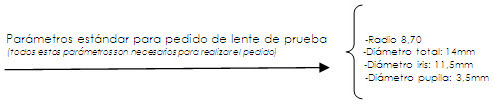
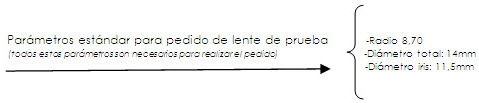
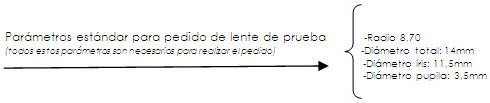
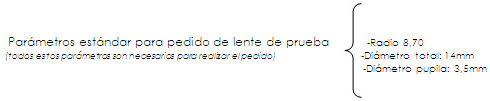
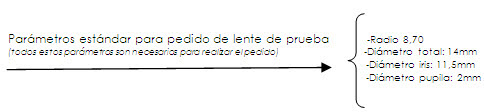
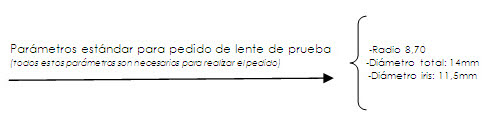
We'll start with a test lens with standard parameters:
- 8.70 radius
- 14mm total diameter lens
LENS POWER
If the patient needs graduation, the lens only can be A Type or Pinhole, simply fill in the required parameters to produce an A Type or Pinhole lens and add the desired graduation (until +/- 20.00D in 0.50D steps)
1.2. SECOND VISIT: Test lens adaptation and measure taking
TOTAL DIAMETER AND RADIUS OF THE LENS
We adapt the test lens, and if we see that it does not move, that lens parameters will be the correct ones to order a definitive lens.
If we observe that the lens does not just accommodate correctly:
The lens remains OPEN if:
Lens positioned under the upper eyelid or if we see that it shifts.
We'll close the radius (in 0.10 steps until 7.40) and/or we'll expand the diameter (in 0.50mm steps until 16.50mm).
The lens remains CLORED if:
Lens positioned on bottom and it does not go up.
We'll open the radius (in 0.10 steps until 9.60) and/or we'll disminish the diameter (in 0.50mm steos until 12,5mm).
When adapting the test lens, we'll leave a few minutes to settle it down.
It is possible that it can disturb a bit at the beginning, but this discomfort will disappear after a few minutes. Also note that if the discomfort is bearable, we'll take the lens parameters as good, as in its subsequent delivery, we'll explain how to solve this discomfort.
IRIS AND PUPIL DIAMETER
The most practiced method is to compare the diameter with a rule as the used in contactology, for both the iris diameter as the pupil diameter.
In pupil diameter we'll search for an average illumination result with a punctual flashlight and later observing the pupil on ambient light, being the most normal measures from 3m/m to 3'5m/m.
For the iris diameter, the most usual measures are from 11 m/m to 12 m/m.
The iris measures goes from 10m/m to 16m/m in 0'25 steps.
IRIS COLOR
When looking at the color of the iris, it should be done with good light, for example, with a punctual flashlight with a warm light and then watching it with ambient light in order to get an average more real. Once you find the color tone, find the intensity (light/dark) that is the most important thing in this type of lenses.
Always obviate taking colours with solar light or with a light source very intense.
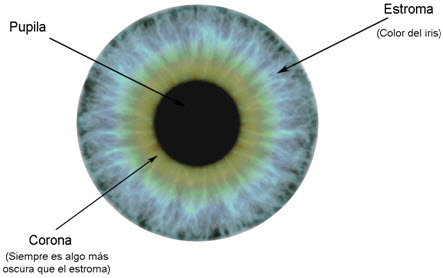
We can get a color reference in order to indicate the crown and another to indicate the stroma... It's important that it be well specified in the order to avoid errors.
We'll do 2 photos to request the color, one for the healthy eye and another for the eye to treat, in whose the color and intensity can be seen correctly, so we'll base on those photos to make the color.
1.3. LENS DELIVERY
If some minutes later we'll see that the lens accomplishes with the ocularist requisites to do a good job in every aspect and the customer is satisfied, we'll end the adaptation and we'll proceed to its delivery.
Finally, we'll teach to remove and place the lens.
MAINTENANCE AND RENEWAL
The prosthesic lenses are soft conventional lenses, its replacement is yearly. Depending on the use that the patient will give to the lens and its care, in some cases its durability can be lower.
The lens durability can be alterated by the use of ocular pharmaceuticals, accelerating the material aging and/or alteration.
The guideline to follow in the sanitation and aseptication is having a unique and conventinoal solution for contact lenses WITHOUT PEROXIDES.
Solutions in cases of discomfort, irritation or itching due to lens:
- Be sure that the lens is completely clean.
- Be sure that it haves no broken zone, it's usual that the patients pinch it with the box to store it, and the lens outline have a little rupture.
- If there's discomfort at the lens delivery, explain that the adaptation can be realized gradually over a few days, that is to say, the first day wear the lens two hours and expand the time slowly as the days goes by. Finally, we'll achieve the complete adaptation in +/- 2 weeks at most.
- If more than a year is passed from the patient got the lens, it might be that it needs a renewal.
2nd.- PROSTHESIC CONTACT LENS RENEWAL:
2.1. 1st case: The lens is well adapted
1st visit::
If the contact lens is well adapted and we simply want to renew it because of the material wear or because its broken, detail in the sheet every information as if we'll going to order a new lens.
If the patient's lens color is correct, it's better to send it to copy it to the laboratory than make the two photos (one for the healthy eye, and another for the eye to treat), because it's very much reliable for the painting staff to have a physic sample.
If there's any variation in data or color indicate it always.
2nd visit:
Lens adaptation following the steps outlined in section 2.2.
2.2. 2nd case: The lens is poorly adapted
If the lens is poorly adapted and we have to change parameters or any other data follow the instructions outlined in the section 1.1.
|